
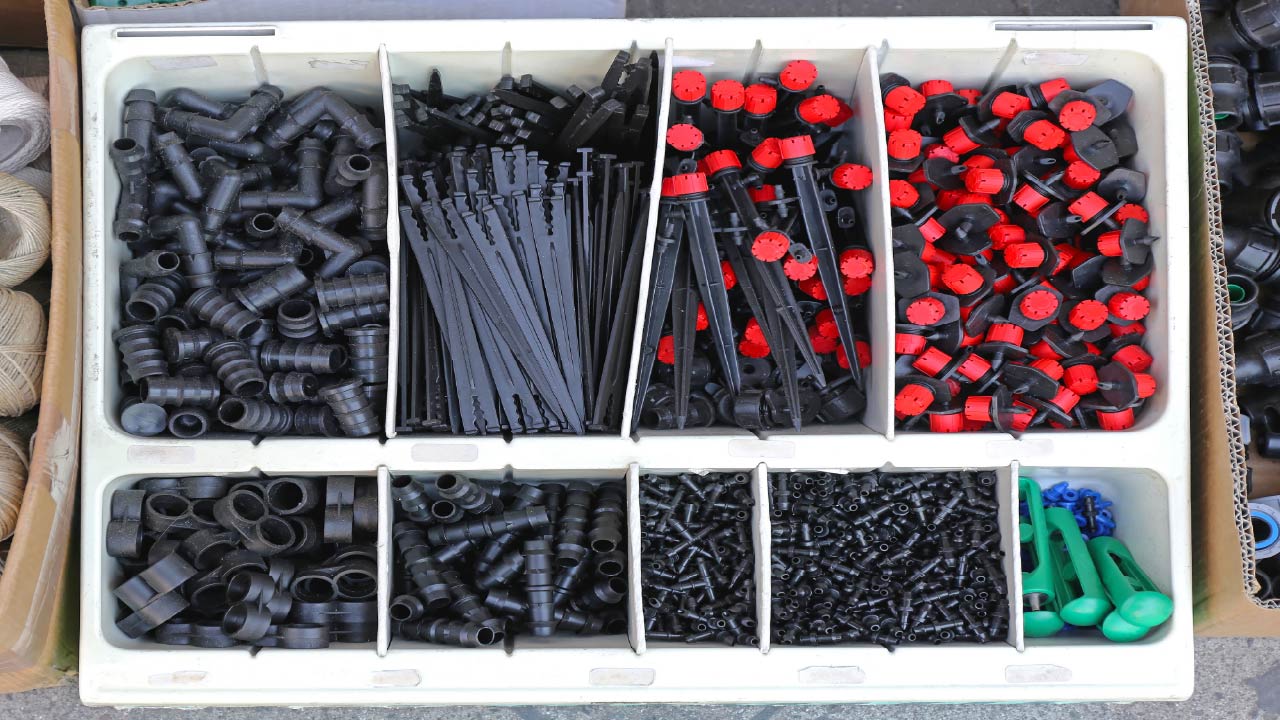
Drip Fitting Sizing: How to Know if the Tubing and Fittings are Compatible
Mar 24th 2026
Drip irrigation is one of the most efficient watering systems available for modern gardens and landscapes. However, many gardeners and landscapers run into problems when building or expanding their systems. The most common issue is the compatibility of drip irrigation tubing and fitting sizes. Even though components may appear similar, small differences in tubing diameter can make fittings incompatible. For example, tubing labeled as ½ inch may vary in sizes between .700 OD, .710 OD, .620 OD, 12 mm, or 17mm. Therefore, choosing the right size fittings and tubing is essential for building a leak-free drip irrigation system. For this, you need to understand the types of fittings, compatibility standards, and drip irrigation tubing size.
Getting your drip irrigation fitting compatibility and sizing right with the tubing is the difference between a high-efficiency, long-lasting system and a frustrating mess of leaks. In this article, we will explore drip tubing measurements, fitting types, compatibility issues, and expert installation tips to successfully build or upgrade your drip irrigation setup.
Drip Irrigation Tubing and Fitting Compatibility
One of the biggest challenges in drip irrigationn is the compatibility of tubing. Drip irrigation components are not always the same across brands. Many systems use tubing labeled ½ inch, but the actual diameter can vary significantly by manufacturer. These small variations affect how well fittings connect to the tubing. Even small differences can prevent fittings from sealing properly.
Common tubing diameters include:
- .700 OD tubing
- .710 OD tubing
- .620 OD tubing
- 17mm tubing
If the tubing is too small for a fitting, the connection will be loose and leak. If the tubing is too large, the fitting may be impossible to insert.
When fittings are incompatible or of the wrong size, your system may experience:
- Leaking connections
- Uneven water pressure
- Reduced irrigation efficiency
- Constant repairs and frustration
Proper fitting compatibility ensures that your drip irrigation system:
- Works efficiently
- Maintains consistent water pressure
- Saves water and fertilizer
- Requires minimal maintenance
Inside Diameter vs Outside Diameter Tubing Measurement
When choosing drip tubing size, you should understand how tubing is measured. The most common mistake in drip irrigation is assuming all mainlines are created equal. Although most standard drip tubing is referred to as a ½ inch Polyethylene main line, the Outside Diameter (OD) varies widely across brands.
There are two key measurements: Inside Diameter (ID) and Outside Diameter (OD).
Inside Diameter (ID)
The inside diameter measures the width of the interior water channel inside the tubing. It determines how much water can flow through the pipe.
ID affects:
- Water flow rate
- Pressure capacity
- System performance
Outside Diameter (OD)
The outside diameter is the total width of the tubing, including the wall thickness. This measurement determines which fittings will fit properly.
Most drip irrigation fittings are designed to match the outside diameter, not the inside diameter.
For example, tubing labeled ½ inch may have an OD of 0.700 inches, while another brand may have an OD of 0.710 inches OD. They are both labeled the same size, but they may require different fittings. If your fitting is even 0.01 inches off from your tubing size, the water pressure will eventually pop the connection.
.700 OD vs .710 OD vs .620 OD Tubing
Even small variations in tubing diameter can affect fitting compatibility.
Here are the most common differences you will find in tubing.
.700 OD Tubing
This is one of the most common ½ mainline tubing sizes offered by many drip irrigation brands.
Features:
- Outside diameter: 700 inches.
- Fully compatible with Easy Loc fittings, compression fittings, and barbed fittings.
- Widely used in small to medium home garden drip systems.
.710 OD Tubing
Some brands create tubing with a slightly larger outside diameter of .710 OD. This tubing is not compatible with 0.700" compression fittings.
Features:
- OD: 710 inches.
- Requires fittings specifically designed for a 0.710 size.
- Used in professional landscape irrigation.
.620 OD Tubing
This tubing is slightly smaller and may require specialized fittings.
Features:
- OD: 620 inches.
- Compatible with .620" OD Easy Loc fitting.
- Typically found in some older drip irrigation systems.
These differences may look small, but they're significant, and using the wrong fitting can cause leaks or failed connections.
Common Drip Irrigation Tubing Sizes
Now let's look at the most used tubing sizes in drip irrigation systems.
1. 1/2" Drip Irrigation Tubing
This is the most common size used for garden beds and landscape irrigation. The 1/2 inch polyethylene main line is the most widely used tubing in drip irrigation systems. It is used as the main distribution line that supplies water from the faucet to emitters and drip lines.
Features:
- Outside diameter: about 0.700 inches
- Inside diameter: about 0.600 inches
- Used as the main distribution line
This tubing is used to irrigate:
- Vegetable gardens
- Raised garden beds
- Flower beds
- Shrub Irrigation
2. 5/8" Drip Tape Tubing
This tubing is used to irrigate long, straight row crops in professional landscaping installations. Drip tape is measured in "mils". You will find drip tape thicknesses ranging from 6 mils to 15 mils, allowing you to choose the right product for your project. Unlike the thick-walled 1/2-inch main line, drip tape is a thin-walled tube. When the water is off, it looks like a flat ribbon, and when the water is on, it rounds out to its 5/8" diameter.
Standard drip irrigation fittings, like compression or simple barbs, cannot be used with this tubing. Only our 5/8" tape fittings work with drip tape.
This tubing is commonly used in:
- Vegetable gardening
- Large-scale farming
Benefits include:
- Stronger connections
- Improved durability
- Better pressure handling
3. 3/4" Drip Irrigation Tubing
Larger drip irrigation setups use 3/4-inch poly tubing for main supply lines. This supply line can be used as a primary header line for a larger water source.
Common uses:
- Large home gardens
- Orchards
- Farms
- Commercial landscapes
Benefits include:
- Higher water flow capacity
- Excellent pressure distribution
- Ability to support long irrigation runs
4. 1/4" Micro Tubing
This smaller tubing distributes water from the mainline to individual plants. ¼" micro tubing serves as the distribution tubing to connect 1/4" micro fittings, drip emitters, and mini-sprinklers directly to your mainline. Micro tubing connects using only barbed fittings.
Uses:
- Container gardens
- Hanging baskets
- Individual emitters
- Spot watering
Blue Stripe vs Green Stripe Tubing
Some drip irrigation tubing comes with colored stripes to help identify the type of tubing.
Two common examples include:
Blue Stripe Tubing
Blue stripe tubing is often used as:
- Drinking-water-safe polyethylene tubing
- Main supply lines
- Higher quality irrigation tubing
Green Stripe Tubing
Green stripe tubing is used to indicate:
- Landscape drip irrigation tubing
- Compatibility with specific fittings
Note: Stripe color can vary across manufacturers, so it should not be relied on as the sole indicator of compatibility. Always verify tubing diameter before buying fittings.
Low-Density vs. High-Density Tubing
Another factor affecting compatibility is the type of polyethylene used.
Low-Density Polyethylene (LDPE)
Low-density tubing is the most common material used in drip irrigation. This is the standard tubing used for most residential drip systems. It is flexible, easy to punch holes in, and handles curves well. You can easily weave it through a landscape, and it's soft enough to punch holes in for emitters.
Most 1/2-inch polyethylene mainline tubing is made from LDPE.
Benefits:
- Greater flexibility
- Easy installation
- Good resistance to cracking
High-Density Polyethylene (HDPE)
HDPE tubing is stronger, more durable, and more rigid. It's often used for sub-main lines that need to withstand higher pressure or burial. HDPE tubing is often used in larger irrigation systems or commercial installations.
Benefits:
- Higher pressure tolerance
- More durable
- Less flexible
Discover How to Save Time with a Drip Irrigation System
Types of Drip Irrigation Fittings
Once you know your tubing sizing, you have to choose how to lock those pieces together. Drip irrigation fittings are the connectors that hold the entire system together. For ¼" poly micro-tubing, the fitting choice is easy because there is only one type available, and that is barbed.
However, for other tubing sizes, other fitting styles are available. Those types include Barbed, Compression, and Perma-Lok fittings. Always choose the right type for tight connections and efficient water distribution in your landscape.
1. Barbed Fittings
Barbed fittings are the most widely used connectors in drip irrigation systems. They are available for use with ¼", ½", ¾", and a few for 1" tubing sizes. They work by pushing into flexible tubing to create a tight seal, used with clamps. You just need to push the fitting into the open end of the tubing as far as possible.
Common types include:
- Barbed tees
- Barbed elbows
- Barbed couplers
- Barbed end caps
Pros
- Easy installation
- No tools required
- Secure connections
Cons
- Difficult to remove and reuse anywhere
2. Compression Fittings
Compression fittings are popular for large-scale projects due to their low cost. These drip fittings grip the outside of the tubing instead of inserting into it. You push the tubing into the fitting. These fittings are often used with 1/2" drip tubing.
Benefits include:
- Easy installation
- Removable connections
- Good for repairs
Note: Compression fittings are sized for a single outside diameter of tubing because they do not fit a size range, unlike barbed fittings and Perma-Loc or Twist-N-Lok fittings. So, if your tubing has a .700" OD, you will need a .700" compression fitting.
3. Perma-Loc Fittings
Perma-Loc fittings (also known as "Easy Loc" or "Spinlock") are widely considered the gold standard for 1/2-inch drip irrigation fittings. They are easy to install, highly durable, and reusable. Due to their extreme durability, Perma-Loc fittings are recommended for use on all projects. They feature a threaded locking nut that twists over the tubing once it's pushed onto a barb. It creates a secure lock that handles higher pressure better than standard friction barbs.
Pros
- Easier on the hands.
- Offer a secure "mechanical" lock.
Learn How to Fix a Leak in a Drip Irrigation System
How to Match Fitting to Tubing Size
If you are unsure which fitting works with your tubing, follow these steps to avoid compatibility issues.
Step 1: Measure Outside Diameter
Measure the tubing OD using a caliper or ruler to confirm the sizing.
Step 2: Stick With One Brand When Possible
It is recommended to use drip components from the same manufacturer for enhanced compatibility. Its benefits include:
- Matching diameters
- Better sealed connections
- Easier installation
Step 3: Identify Tubing Type
Check if the tubing is:
- Standard 1/2-inch tubing
- micro tubing
- Drip Tape
Step 4: Choose Compatible Fittings
Always fittings designed specifically for that tubing diameter. If you buy your tubing or drip tape from DripWorks, order fittings that match the size listed in the tubing's description. For example, if you ordered 1/4" polyethylene micro tubing, then any of our 1/4" micro fittings are guaranteed to fit. This holds true for all drip tubing, drip tape, and fittings sold by DripWorks.
Step 5: Test the Connection
Insert the fitting and confirm the seal connection is tight, there are no leaks, and the system pressure is appropriate.
Also Read: Drip Irrigation Installation for Beginners: Easy DIY Setup Guide
The Bottom Line
The success of your drip irrigation system depends on choosing the right drip irrigation fitting that is compatible with the type and size of tubing. Drip components may vary by manufacturer, so you should always check tubing tubing diameters, fitting types, and connection standards. With the right knowledge and a few installation techniques, you can create a durable, leak-free, sustainable, and highly efficient irrigation system for your landscape.